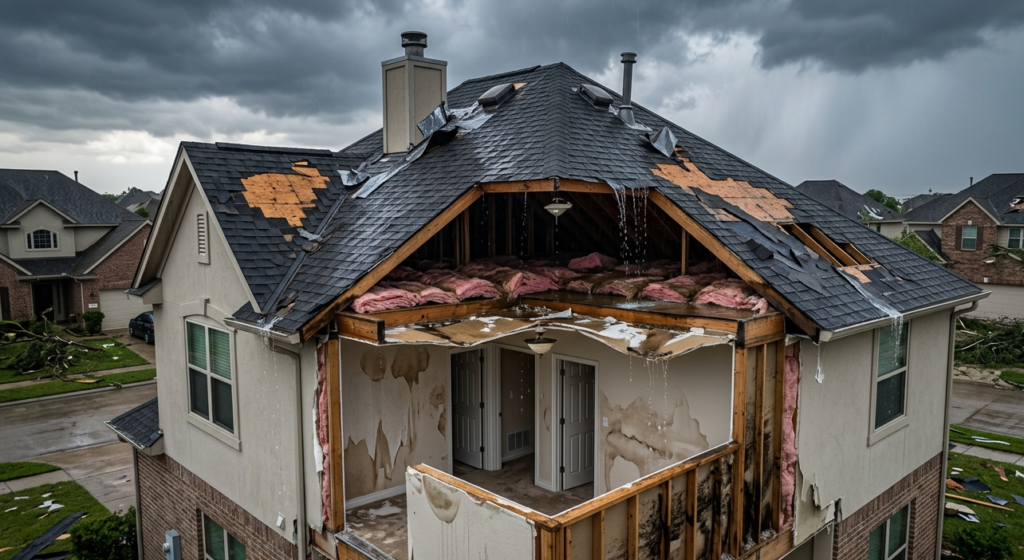
After a storm, the roof is usually the most visible damage – missing shingles, lifted flashing, damaged ridge caps. But the roof failure is only the beginning of the problem. What it allows into your home – water – continues causing damage long after the storm has passed and the roofer has left. Understanding why you need two separate contractors, in the right sequence, is how you avoid a partial fix that turns into a mold remediation six months later.
What the Roofer Fixes
A roofing contractor’s scope is the building envelope – restoring the roof’s ability to shed water and protect the structure from future intrusion. That work includes:
- Emergency tarping and board-up immediately after the storm to stop active intrusion
- Full damage assessment once conditions are safe
- Repair or replacement of shingles, underlayment, flashing, ridge vents, and penetrations (chimney, skylights, HVAC curbs)
- Gutter and fascia repair associated with wind damage
- Documentation for insurance claims (aerial or drone imagery, material quantity estimates)
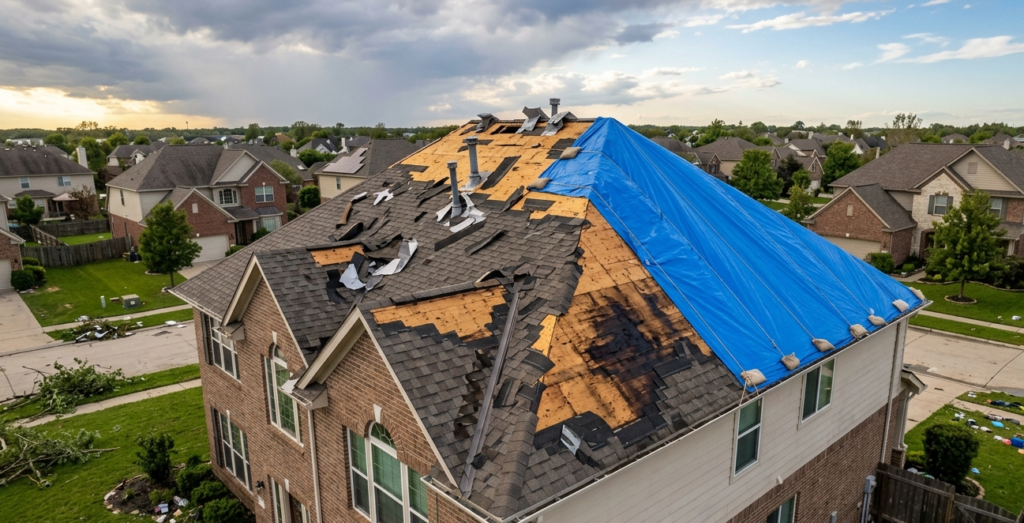
A roofing contractor does not dry the structure. They do not extract standing water from an attic or ceiling cavity. They do not assess or remediate the moisture that has already absorbed into framing, insulation, and drywall before they got on site. That work belongs to a different trade entirely.
What Has Already Happened Inside
Here’s the timeline that most homeowners don’t fully appreciate: a roof failure during a storm event typically allows water intrusion for hours before the homeowner is even aware of it. By the time the storm passes, re-entry is permitted, and a roofer is scheduled, the interior has often been wet for 12–36 hours.
In that window, the following has already occurred:
- Attic insulation (fibreglass batts or blown cellulose) has absorbed water and collapsed, losing most of its R-value
- Roof sheathing has begun to swell and check (crack along grain lines)
- Ceiling drywall has absorbed water from above and may already be bowing
- If any ceiling penetration occurred, water has tracked along ceiling joists into wall cavities
- In warm, humid climates, the 24-hour mold initiation window may already be closed
None of this is visible from the roof. And none of it gets addressed if the only call made is to a roofer.
The Coastal Florida Scenario
Storm-related roof damage is endemic to Florida and the broader Gulf and Atlantic coasts. Tropical systems, even weak ones, routinely produce wind speeds sufficient to damage roofing systems – and Florida’s population of older tile, shingle, and flat roofs means that storm impact is widespread after any significant weather event.
In communities throughout Volusia County and along the Daytona Beach coastline, a roof failure during a named storm event almost always means interior water intrusion – and the subtropical climate gives homeowners the shortest possible window to act before secondary damage compounds the primary loss. Experienced providers handling Daytona Beach water damage restoration are structured for exactly this scenario: rapid attic and ceiling inspection, extraction of accumulated water, and structural drying of the framing and drywall that absorbed water during the storm.
The IBHS (Insurance Institute for Business & Home Safety) publishes detailed research on roof performance in hurricane conditions that documents how quickly interior intrusion follows even partial roof system failures – the data reinforces why the restoration response has to run parallel to, not after, the roofing repair.
The Right Sequence After Storm Roof Damage
Day 1 – Emergency response:
- Contact your insurer and open a claim
- Arrange emergency tarping through your roofer (most offer 24/7 emergency service)
- Contact a water damage restoration company for interior assessment simultaneously – don’t wait for the tarp to go on
Day 2–3 – Parallel assessment:
- Roofer performs full damage assessment and submits estimate to insurer
- Restoration contractor performs moisture mapping of attic, ceilings, and any affected wall cavities; extraction equipment deployed where standing water is present
Day 4–10 – Drying and documentation:
- Structural drying continues (typically 3–5 days for ceiling/attic water intrusion)
- Roofer schedules repair or replacement once materials are available
- Restoration contractor provides daily drying logs
Day 10+ – Rebuild:
- Roof repair or replacement complete
- Interior rebuild (drywall, insulation, paint) begins once restoration contractor issues a drying completion certificate
This sequence ensures nothing is rebuilt over moisture – which is the single most common cause of mold appearing 6–12 months after an “already fixed” storm claim.
Insurance Considerations
Storm-related roof damage that causes interior water intrusion is typically covered under standard homeowners policies as a sudden and accidental loss. However, insurers will often scrutinise whether pre-existing roof deterioration contributed to the failure – your roofer’s assessment should clearly document storm causation versus wear-and-tear for any contested elements.
On the water damage side, your adjuster will want to see the moisture documentation from the restoration contractor – moisture readings at time of discovery, drying logs, and a final drying certificate. This documentation is what distinguishes a properly remediated claim from one that comes back as a mold dispute.
Conclusion
Roof damage and interior water damage are two parts of the same storm event, but they require two separate licensed contractors with different scopes, tools, and documentation. Getting the roofer on the phone is the instinct – and it’s right. But the restoration call needs to happen in the same hour, because the damage inside your home doesn’t pause while the shingles get replaced.
Al Schmidt Roofing provides residential and commercial roofing repair, replacement, and storm damage response. We work alongside water damage restoration professionals to ensure complete post-storm recovery for our clients.
Leave a Reply